
Conformity
Healthcare teams need and often thrive on commonality and even conformity. Protocols, role clarity and coordinated action can make complex care safer and are often promoted.

Social Forces
The same social forces that enable slick CPR performance and the team displaying ‘relational coordination‘ (shown above) can become dangerous when clinicians fail to communicate uncertainty or consider alternative explanations during an emergency.
They may suppress their instincts and doubts, accept an incorrect diagnosis from a senior colleague or follow the group despite conflicting evidence.
Recognising that the pressure of an emergency has shaped your own judgement, or the collective judgement of the team, can be uncomfortable.
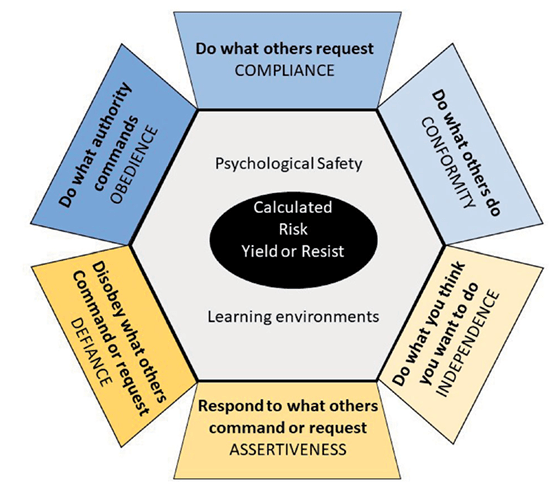
Altabbaa and colleagues (the authors’ figure pictured above) argue that simulation should help clinicians recognise and manage conformity pressure within a psychologically safe learning environment.
In terms of learning and simulation design this idea requires careful scenario choice, pre-briefing and reflective debriefing.
The aim isn’t to promote conflict / dissent and/or teach an over use of Graded Assertiveness, but to help teams recognise uncertainty, question assumptions and know when agreement should give way to healthy discussions about patient care.
Can reflections occur during a Resuscitation?
Efforts to support speaking up should not be confined to debriefing after simulation.
Schmutz and Eppich show how team reflexivity can be operationalised before, during and after care, creating repeated opportunities to surface uncertainty and reconsider the team’s plan.
As the model below illustrates, in resuscitations there are continuing interactions between the individual, the group and the situation.
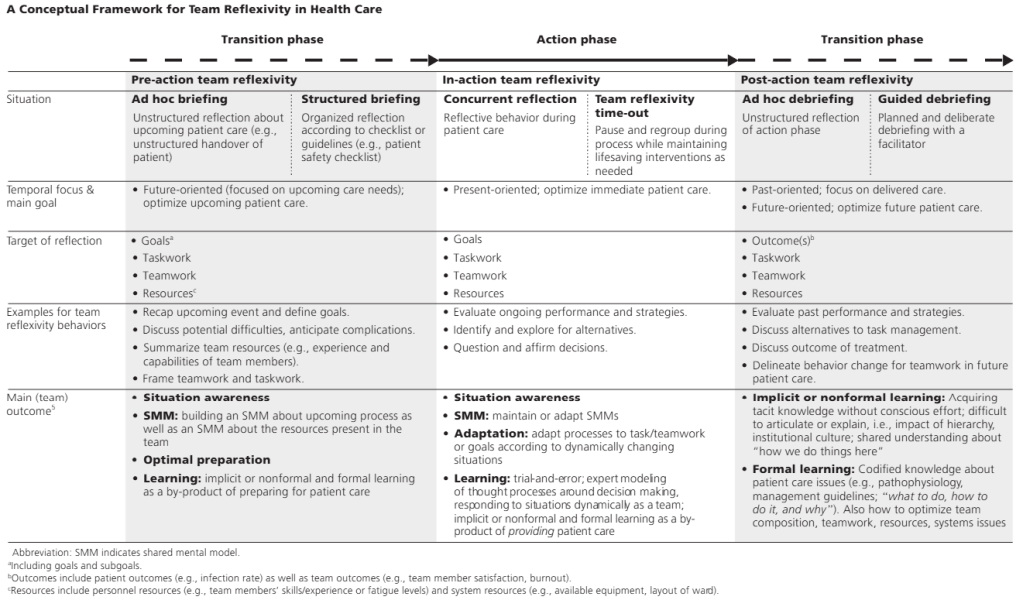
Before resuscitations, our teams can clarify roles, anticipate uncertainty and establish that concerns are welcome.
During care, they can pause briefly, share their current understanding, seek alternative views and adapt the plan.
After care, they can examine how hierarchy, emotion and social pressure influenced what was noticed, voiced and acted upon.
Approachability and Inclusive Communication
Usually in the simulation centre we recommend team leaders actively create the conditions in which speaking up is welcomed.
Communication lapses can occur unintentionally amid the distractions and interruptions of an Emergency case… but saying nothing is different… a clinician thinks, notices, questions but does not voice it – and is aware of the choice NOT to speak up… often because hierarchy, uncertainty or interpersonal risk makes speaking up feel unsafe.
Our decisions to act or not act are conscious… in other words, to question, agree or remain silent is an active thought… speaking up is neither purely individual nor a choice made I unconsciously…

In healthcare teams, treating direct speaking up strategies such as the commonly taught graded assertiveness as the primary solution risks placing responsibility on the least powerful team member: “recognise the danger, overcome the pressure and speak more forcefully.”
This in our experinece may not always work in the real world. Pack and colleagues give an opinion on team leader approachablity being important in these situations….
Their simulation study found that leaders sometimes misunderstood their own approachability being simply being fine as long as they were ‘not hostile’…

Team leaders need to be more active an encouraging speaking up.
For example they should consider sharing vuberability and using inclusive language….

Where appopriate they can also share their level of (un)certainty by sharing their mental model and thinking aloud.
They should also encourage suggestion in the pre-brefing (ideas welcome) and receive new ideas warmly even if they disagree… If a team leader cannot follow or disagrees with a team members suggestion, their response matters.
For a nonurgent idea, they might say, “Thank you for raising that. I appreciate the suggestion. Can we record it and return to it shortly?” However, a concern involving immediate harm deserves an immediate response rather than being parked.
When a suggestion cannot safely be followed, the leader should clearly explain why. During a resuscitation, leaders should invite alternative views, acknowledge uncertainty and treat questions as contributions rather than disruptions.
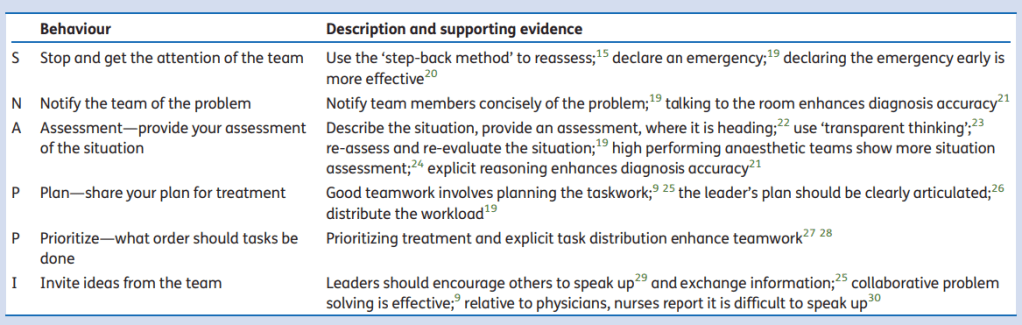
If you need an example if what this might look like Weller et al described an approach to top down sharing in this paper:
Indirect Communcation
Taylor and colleagues add another dimension to this issue. The paper is unsettling but important… In their simulation study, the team leader acted as a “mole,” deliberately introducing errors in clinical judgement and lapses in professionalism. Lower-authority team members usually challenged these actions indirectly. For example speakin up was done through subtle language, questions or nonverbal cues. It was NOT done through explicit communication.

Moreover, even in the face of clear errors and lapses in patient safety, the communication remained indirect, subtle, and sometimes non-verbal. Whether the simulated patient was awake or unconscious influenced how participants communicated.
Senior clinicians dscribed in Taylor’s study were thought to be receptive to indirect challenge, particularly in front of the awake patient. In thw awake patient a blunt challenge using a graded assertiveness tool could be perceived as undermining of the patient’s trust, embarrassing, disrupting of teamwork or provoking conflict. Indirect communication is therefore not necessarily weak communication; it may be a sophisticated attempt to balance safety with competing relational demands.
Graded assertiveness still has an important role where the above affodances fail… particularly when risk is escalating or patient harm is imminent. Simulation practice of multiple strategies should help junior clinicians escalate their concerns clearly while teaching leaders to notice questions, hints and hesitation rather than waiting for a perfectly scripted challenge. The takeaway for both teachers and learners is not just to be brave but also to speak up and promote speaking up using multiple strategies. These ideas prevent graded assertiveness from being prescribed to junior learners as a miracle cure. It also avoids shifting responsibility onto those with the least power and requiring heroism from junior clinicians simply to keep patients safe.

